The glass has a story, too
Hello New Canaan,
A window is easy to forget when it does its job. You look at the tree, the street, the person coming up the walk. The glass stays out of the way.
Then you come across an older pane that makes a straight line look a little wobbly. A reflection shifts as you move past. Suddenly, the window itself has your attention.
Some of that character comes from the way the glass was made. Before today’s very flat sheets, making a window could begin with a glassblower shaping a hollow cylinder or spinning a disc. A pane could retain a trace of that work.
How a round thing became a flat window
Two older methods are worth knowing. For cylinder glass, the maker blew a cylinder, cut it open and flattened it in a furnace. For crown glass, molten glass was blown and spun into a broad disc, then cut into panes. Historic Environment Scotland’s guide explains both processes.
Flattening a curved surface could leave ripples behind. Conservators at Glasgow Museums describe the difference: crown glass cut near the center of its disc often has curved ripples, while cylinder glass has parallel ones. Those marks are clues to manufacture.
Modern float glass takes another route. Molten glass spreads over a bath of molten tin, producing the flat surface now familiar in windows. That is why the view through an old pane and a modern one can feel different even when both are clear.
Try looking at the reflection of a straight edge in a window as you move a few steps along it. Does the line stay straight or seem to bend? Can you notice a faint tint or small bubbles? You don’t have to identify a manufacturing method to enjoy noticing the surface. It’s a way to see a familiar building as something people made, one material at a time.
A window that asks you to look at it
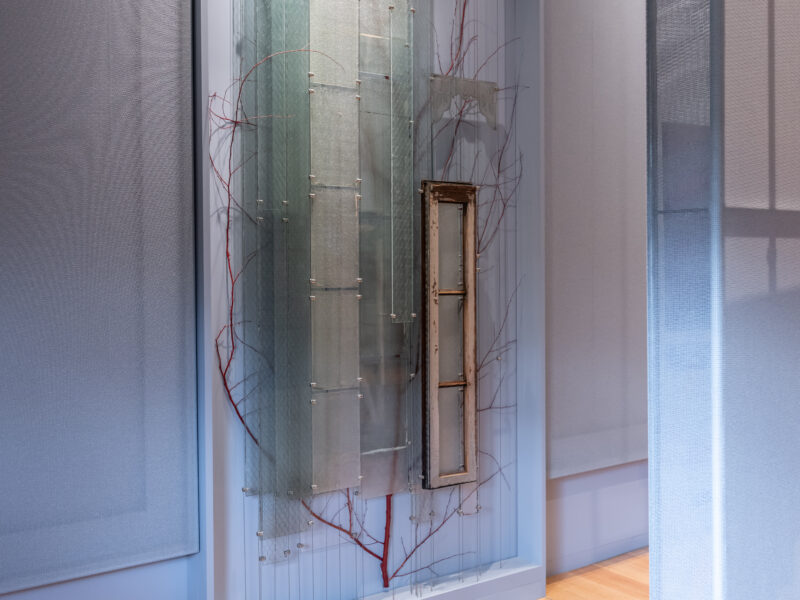
At Grace Farms, architect Nina Cooke John makes glass the subject of Material Clarity, an installation in the With Every Fiber exhibit. Reused strips overlap in different densities, with clear, ribbed and other textured glass set against a painted branch. How much of the branch you can see depends on the glass between you and it. An old frame remains part of the composition.
According to Grace Farms’ account of the artwork, Cooke John sourced the salvaged pieces, still in their framing, from a local salvage yard that is part of Habitat for Humanity ReStores. A window that once belonged to a building gets another role: helping you notice the material you normally look through.
There is a useful distinction here. The ripples in an old pane are traces of a manufacturing process. The arrangement of panes in this artwork is a new decision about what to reveal and what to obscure. Looking closely can take you in either direction—back toward the making, or forward toward a new use.
The wider exhibit asks visitors to consider where building materials come from and the people involved in producing them. Its focus on pigment, stone and glass connects the appearance of a finished building to the work that made it possible. The glass installation gives you a concrete place to begin that larger question.
If you visit with someone, choose a detail to find together: the outline of the branch, a texture that changes the view, or the edge of the old frame. Then compare what caught your attention first. You might spend longer with one object than you would on a quick sweep of an entire room.
With Every Fiber is in the West Barn at Grace Farms, 365 Lukes Wood Road, New Canaan. Admission is free; schedule your visit directly with Grace Farms. Regular hours are Tuesday–Saturday, 10 a.m.–5 p.m., and Sunday, noon–5 p.m.; it is closed Mondays. Check the calendar for exceptions. Our Grace Farms guide has more background for planning a visit.
A chance for children to try a materials experiment
Next Wednesday’s Materials Studio invites children ages 4–11 and their adult caregivers to build, take things apart and imagine new uses for everyday materials. The education team draws inspiration from the exhibit. It’s a way to turn a question about how something was made into something children can explore for themselves.
Wednesday, November 25, 10 a.m.–noon, at Grace Farms, 365 Lukes Wood Road, New Canaan. The studio is included with free daily registration. Program details and November 25 visit registration.
Three more plans for November 19–25
Browse the Nature Center’s Holiday Market
The market brings together gifts including jewelry, clothing and candles, with live holiday music. It’s a chance to get an early start on gifts before Thanksgiving week arrives. Admission is free.
Market details →Take a first step from reading poetry to writing it
Local high school author Sofia Giammarco discusses her poetry collection, The Colors of Shadow and Rain, answers questions and leads a short writing workshop. The free program is for tweens, teens and adults. Register ahead; signup closes at 9 a.m. Saturday.
Workshop and registration →Make something for the window at home
New Canaan High School art students help children in grades 3–5 make Thanksgiving-themed suncatchers, with materials provided. The class is free and requires registration. Caregivers of children under 12 must remain in the Children’s Room during the program.
Suncatcher class and registration →Before you head out
Browse the full New Canaan events calendar for more plans, and check the organizer’s page before booking or leaving home.
Is there a small architectural detail in New Canaan that you always stop to look at? Reply with where to find it and what makes it worth noticing.
See you around town, Shop New Canaan Association